


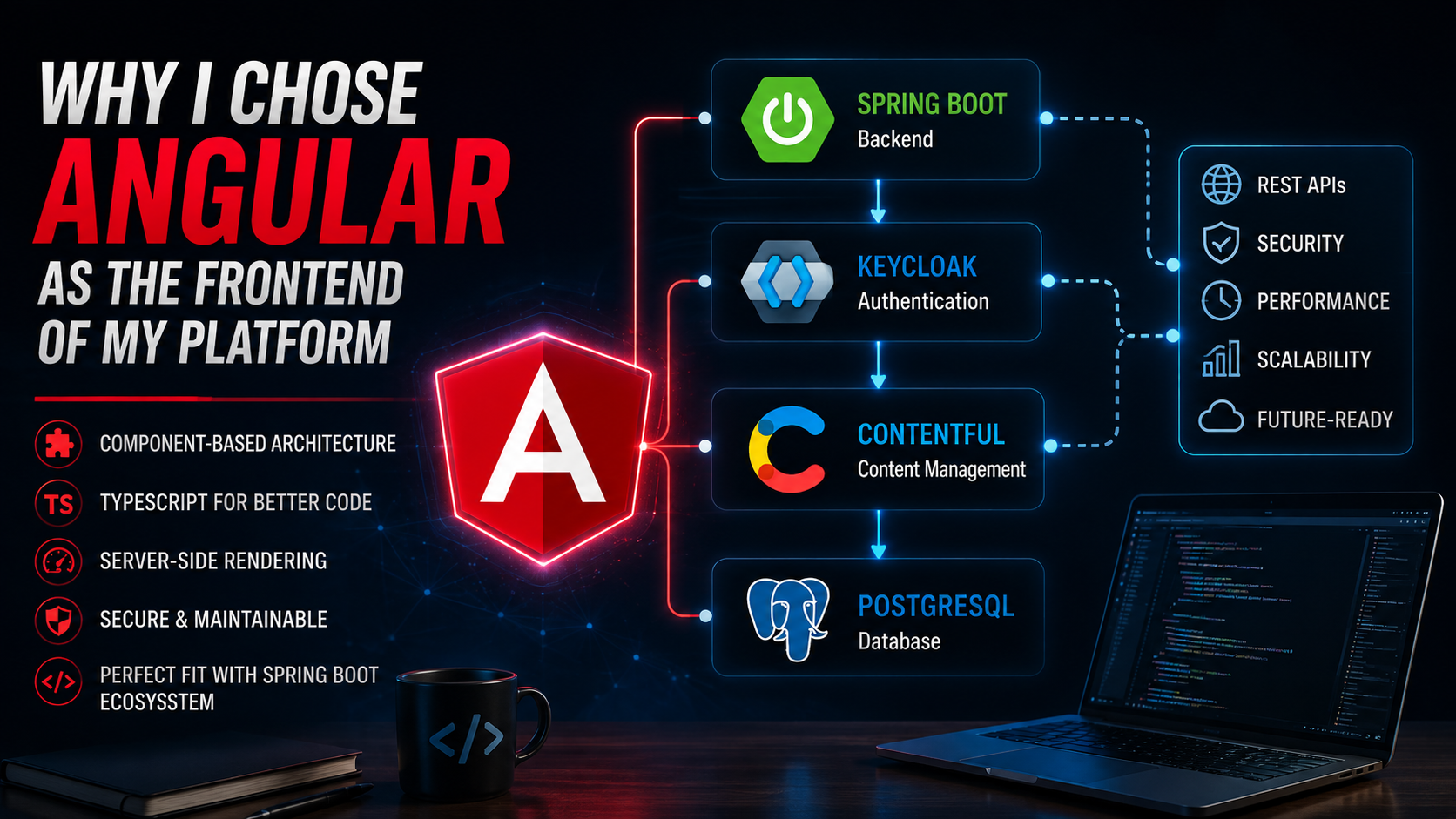
Why I Chose Angular as the Frontend of My Platform
Discover why I chose Angular as the frontend foundation of my enterprise platform and how component-based architecture, TypeScript, Server-Side Rendering, and clean software design help build scalable applications that last for years.
Building for the Next Ten Years
When I started designing my platform, I wasn't looking for the newest frontend framework.
I was looking for one that could support a growing enterprise application for many years.
Frontend technology changes constantly.
Frameworks come and go.
My goal was different.
I wanted an architecture that would remain maintainable, scalable, and easy to extend long after Version 1.
That was the beginning of my Angular journey.
🌍 Building More Than Just a Frontend
From the beginning, I knew this wouldn't become a simple website.
The frontend would eventually include:
🔐 Authentication & Authorization
👤 Member Area
📰 Technical Blog
💹 Finance Portal
📚 Knowledge Platform
🌍 Multi-language Support
📊 Dashboards
⭐ Personal Watchlists
🔍 Advanced Search
📱 Responsive Design
⚡ Server-Side Rendering
🚀 Future AI Features
That required much more than rendering HTML.
It required a real application framework.
💡 Why Angular?
Today there are many excellent frontend frameworks.
🔴 Angular
🔵 React
🟢 Vue
⚫ Svelte
⚪ SolidJS
Every one of them is capable of building modern applications.
For my platform, however, Angular offered exactly the characteristics I was looking for.
Not because it is the most popular.
But because it fits the way I design software.
🧩 Component-Based Architecture
One of Angular's greatest strengths is its component model.
Every feature becomes an isolated building block.
Examples include:
Navigation
Header
Footer
Dashboard
Watchlist
Login
User Profile
Finance Widgets
Knowledge Cards
Each component has one responsibility.
That makes testing easier.
Maintenance simpler.
And future development significantly faster.
🏛️ Object-Oriented Thinking
My professional background is Java.
For many years I've developed enterprise applications using Spring Boot.
That means I naturally think in:
Classes
Interfaces
Dependency Injection
Encapsulation
Clear Responsibilities
Angular follows the same philosophy.
TypeScript makes frontend development feel very similar to backend development.
Frontend and backend become one consistent architecture.
🚀 Why TypeScript Matters
JavaScript is incredibly flexible.
TypeScript adds structure.
Benefits include:
Static typing
Better IDE support
Refactoring safety
Cleaner APIs
Better maintainability
Easier collaboration
For large applications, these advantages become increasingly valuable over time.
🌐 Angular + Spring Boot
The platform is divided into clearly separated responsibilities.
🎨 Angular
Responsible for:
User Interface
Routing
Components
State
Forms
Client-side logic
⚙️ Spring Boot
Responsible for:
Business Logic
REST APIs
Authentication
Data Processing
🔑 Keycloak
Responsible for:
Identity
Authentication
Authorization
📝 Contentful
Responsible for:
Articles
Images
Structured Content
🐘 PostgreSQL
Responsible for:
Persistent Data
Relationships
Transactions
Every technology focuses on exactly one responsibility.
⚡ Server-Side Rendering
SEO was an important architectural requirement.
I didn't want search engines to index empty pages.
Angular Server-Side Rendering allows:
Better SEO
Faster First Contentful Paint
Improved User Experience
Better Discoverability
Fully Rendered HTML
Especially for a knowledge platform, this is a major advantage.
🧪 Quality from Day One
Angular isn't only about components.
It's also about quality.
The frontend architecture includes:
Unit Testing
Playwright End-to-End Tests
Docker
Jenkins CI/CD
Automated Deployments
Lighthouse Optimization
Quality was never planned for later.
It was built into the project from the very beginning.
🚀 Ready for Future Growth
Version 1 is only the beginning.
The architecture already supports future expansion.
Upcoming features include:
📊 Advanced Dashboards
🤖 AI-powered Features
📈 Financial Analytics
🌍 Additional Portals
🔔 Notifications
📱 Progressive Web App
⚡ Real-time Updates
The foundation is already there.
Future features become additions, not redesigns.
🎬 Related Video
Why I Chose Angular for My Enterprise Platform
In this video I explain why Angular became the frontend foundation of my platform.
You'll learn:
why I chose Angular instead of React or Vue
why enterprise architecture influenced this decision
how Angular integrates with Spring Boot
why TypeScript and component-based development matter
why Angular Server-Side Rendering improves SEO
how the platform is prepared for future growth
Rather than teaching Angular syntax, this video explains the architectural thinking behind building a scalable enterprise platform.
✅ Conclusion
Technology trends change every year.
Architecture should survive for many years.
Angular gives me exactly what I was looking for:
🏗️ Component-Based Architecture
📦 Strong TypeScript Support
🔒 Enterprise-Ready Framework
⚡ Excellent Tooling
🧪 Outstanding Testability
🌍 Server-Side Rendering
📈 Scalability
🔧 Maintainability
🚀 Future-Proof Architecture
That's why Angular became the frontend foundation of my platform.
And it's a decision I would make again today.