

From Blog to Knowledge Platform
Discover why this website evolved from a traditional blog into a flexible knowledge platform designed for articles, guides, case studies, and long-term content growth.
From Blog to Knowledge Platform change
Why this website is designed to grow beyond traditional blogging.
🏗️ Introduction
When most people think about a website, they think about pages.
A homepage.
An about page.
A contact page.
Maybe a blog.
That approach works well for many projects, but I wanted something different.
From the beginning, my goal was not simply to publish articles. I wanted to create a platform that could evolve over time, support different types of content, and remain flexible as new ideas emerged.
This website is the result of that approach.
📚 The Problem with Traditional Blogs
Most blogging systems are built around a single concept:
The article.
Every piece of content is treated the same way:
Title
Image
Body text
Publication date
For a typical blog, that is perfectly fine.
However, not all content is an article.
A technical tutorial is different from a project case study.
A case study is different from a guide.
A guide is different from a personal insight or a long-form experience report.
As content grows, forcing everything into the same format often creates unnecessary complexity.
🧩 Thinking in Content, Not Pages
Instead of designing pages first, I chose to think about content first.
The question became:
What types of information do I want to manage?
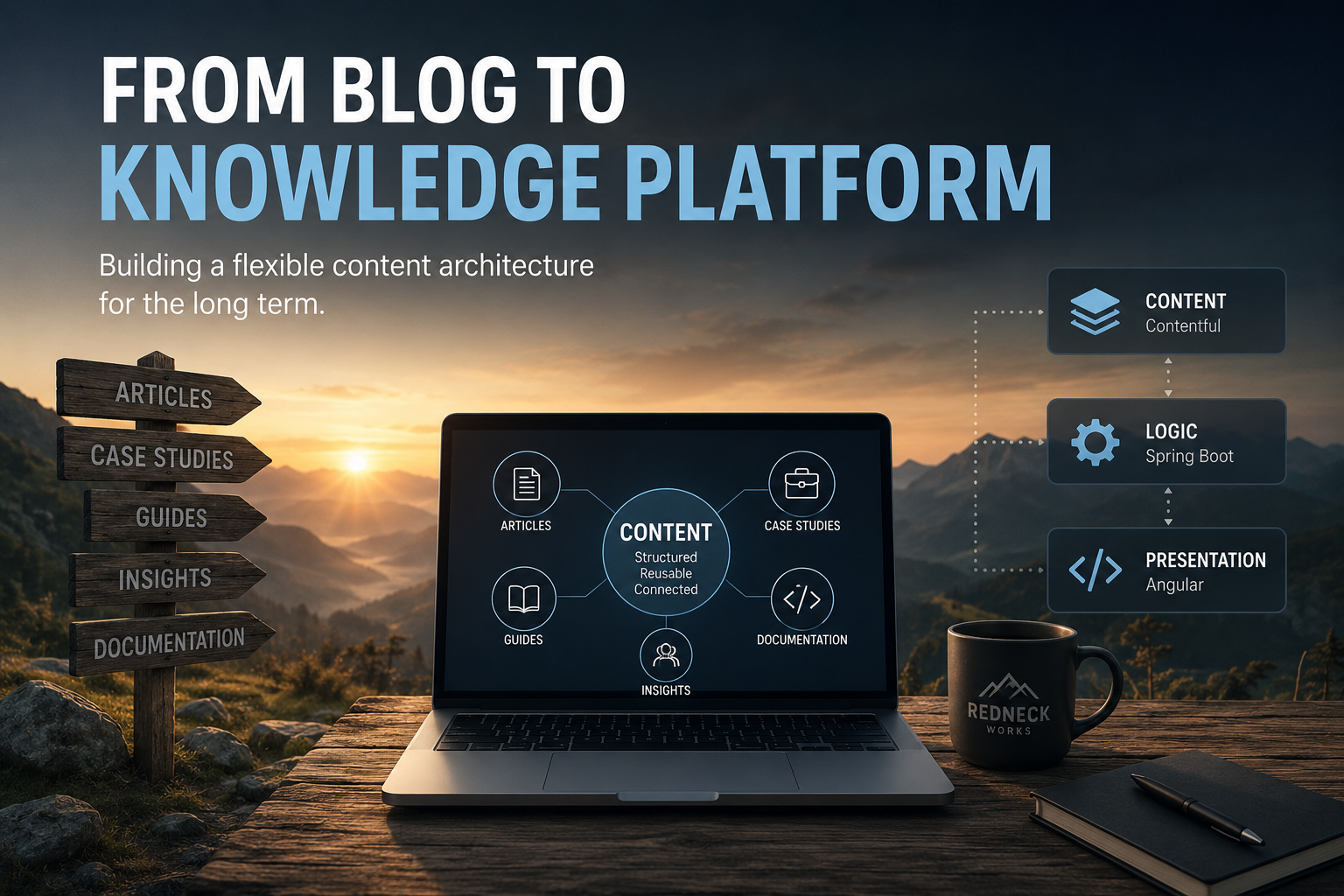
The answer was much broader than a traditional blog.
For example:
Engineering Articles
Technical content about:
Angular
Spring Boot
Software Architecture
Modernization
Integration
Case Studies
Real-world project experiences:
Challenges
Solutions
Outcomes
Lessons learned
Guides
Structured knowledge that spans multiple topics:
Documentation
Handbooks
Learning resources
Best practices
Insights
Personal observations and experiences:
Travel
Remote work
Technology trends
Life abroad
Photography
Financial markets
Each of these content types serves a different purpose.
Each deserves its own structure.
Some of these content types already exist.
Others are part of the platform's long-term roadmap.
The important part is that the architecture was designed to support them from the beginning.
⚙️ One Platform, Multiple Experiences
Today, the platform is primarily centered around articles, technical insights, and project-related content.
However, the underlying architecture was intentionally designed to support much more than a traditional blog.
Future expansions may include:
Knowledge bases
Learning paths
Documentation portals
Member-only content
Premium resources
The platform itself does not need to change.
Only the content and experiences built on top of it evolve over time.
🔗 Why Structure Matters
Good content is not only about writing.
It is also about organization.
When information is structured properly, it becomes easier to:
Navigate
Search
Reuse
Extend
Maintain
A well-structured content model allows related information to connect naturally.
An article can reference a guide.
A guide can reference a case study.
A case study can point to technical documentation.
Over time, isolated content becomes a connected knowledge system.
📈 Built for Long-Term Growth
One of the main goals behind this website was sustainability.
I did not want to rebuild the platform every time a new content idea appeared.
Instead, I wanted an architecture that could grow alongside the content itself.
Today, this vision is still in its early stages.
The current platform represents Version 1.0, with the foundation already in place for future expansion.
That means new sections can be added without redesigning the entire system.
New content types can be introduced without rewriting existing functionality.
The platform becomes an investment rather than a limitation.
🚀 More Than a Blog
Today, the platform still looks very much like a blog.
And that's perfectly fine.
Every platform has to start somewhere.
The difference is that the underlying architecture was never designed to stop there.
Calling this website a blog is not entirely wrong.
There are articles.
There are updates.
There are insights.
But the long-term vision goes beyond blogging.
The goal is to create a place where different forms of knowledge can coexist:
Technical expertise
Project experience
Structured learning
Personal perspectives
All within a single, flexible platform.
🎬 Related Video
💡 Conclusion
Technology changes.
Frameworks change.
Tools change.
What remains valuable is knowledge and the ability to organize it effectively.
The platform is still at the beginning of its journey.
Today, it is Version 1.0.
The foundation is in place.
New ideas, new content types, and new experiences can be added over time without rebuilding everything from scratch.
Because in the long run, content is not just something you publish.
It is something you build upon.