


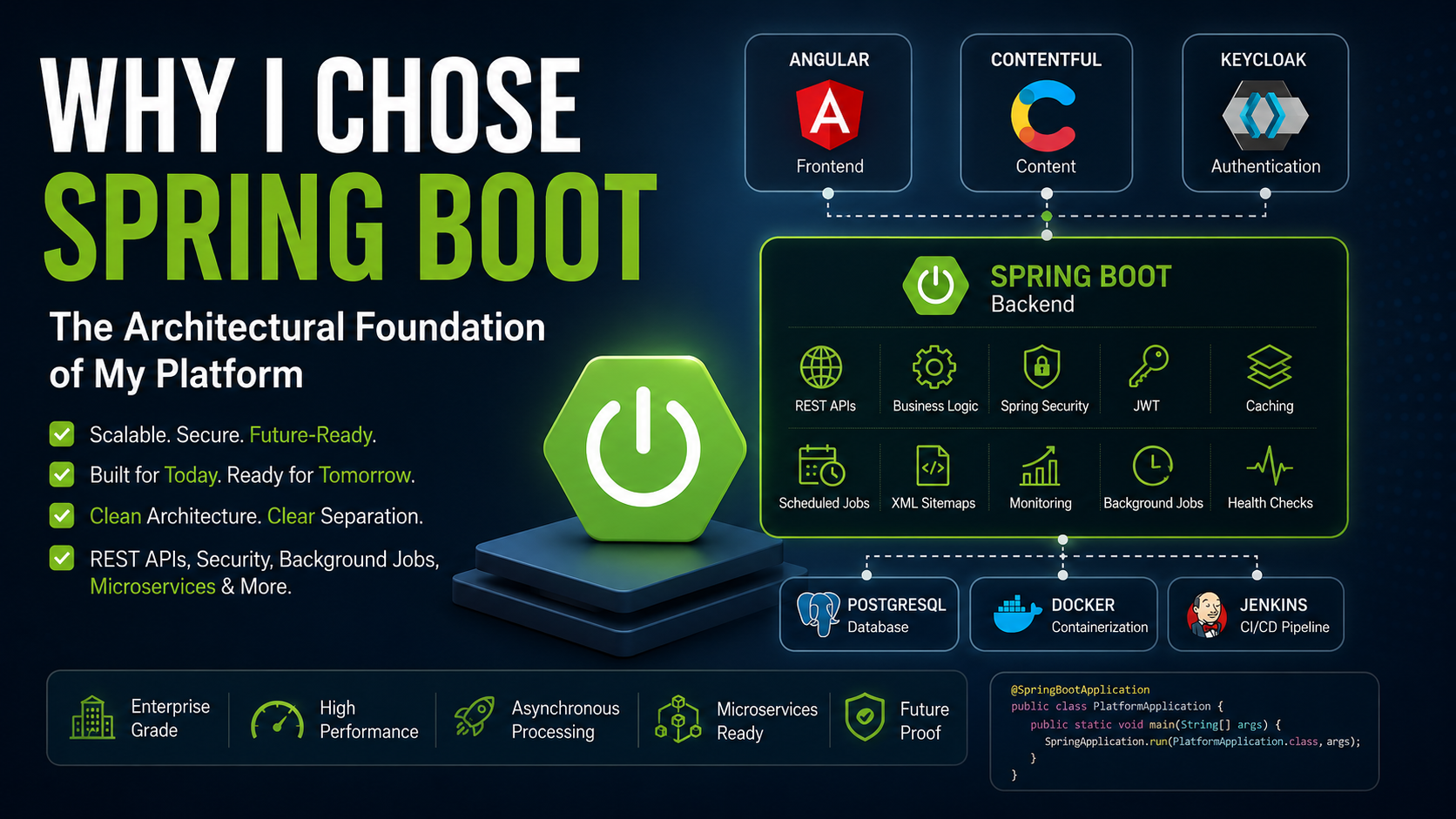
Why I Chose Spring Boot as the Backend of My Platform
Discover why I chose Spring Boot as the foundation of my platform and how it powers a scalable, secure, and future-ready enterprise architecture.
When I started building my platform, I wasn't looking for the newest framework.
I was looking for a technology that would still be the right choice years from now.
For me, the backend is much more than a collection of REST endpoints.
It is the heart of the entire platform.
🌍 Building More Than Just a Website
From the very beginning, I knew this project would grow far beyond a traditional website.
The platform would eventually require:
🔐 Authentication & Authorization
🌐 REST APIs
⚙️ Business Logic
📝 Content Management
⏰ Background Jobs
🗺️ XML Sitemap Generation
⚡ Intelligent Caching
📊 Monitoring
🛡️ Security
🚀 CI/CD Integration
🤖 AI Services
🧩 Future Microservices
That immediately ruled out the idea of using a simple HTTP server.
I needed a complete backend platform.
💡 Why Spring Boot?
Today there are many excellent backend technologies.
🟢 Spring Boot
🟢 Node.js
🟢 ASP.NET Core
🟢 Quarkus
🟢 Micronaut
🟢 Go
All of them are capable of building modern applications.
For my platform, however, Spring Boot offered the best combination of maturity, stability, scalability, and long-term maintainability.
Its enormous ecosystem means that almost every requirement already has a proven solution.
Instead of assembling dozens of individual libraries, I could focus on building my application.
⚙️ What Spring Boot Does Today
Today Spring Boot powers almost every backend responsibility of my platform.
It provides:
🌐 REST APIs
⚙️ Business Logic
🔒 Spring Security
🔑 JWT Authentication
👤 Keycloak Integration
📝 Contentful Integration
🗺️ XML Sitemap Generation
⏰ Scheduled Jobs
⚡ Intelligent Caching
📈 Monitoring
❤️ Health Checks
🛡️ Fail2ban Reporting
Angular focuses entirely on the user interface.
Contentful manages content.
Spring Boot orchestrates everything else.
🏛️ Clean Separation of Responsibilities
One of my primary architectural goals was keeping responsibilities clearly separated.
🎨 Angular
Handles the complete user interface.
📝 Contentful
Manages articles, images, and structured content.
⚙️ Spring Boot
Contains all business logic and coordinates every system.
This separation makes every component easier to maintain, test, and extend.
🚀 Built for Future Growth
The current platform communicates primarily through REST APIs.
That is exactly what the application needs today.
However, the architecture is already prepared for future expansion.
Future services may include:
🤖 AI Service
🔍 Search Service
🔔 Notification Service
📊 Analytics Service
🖼️ Image Processing
📄 Document Processing
Because the foundation already exists, these services can be added without redesigning the platform.
⚡ Asynchronous Processing
Not every task needs an immediate response.
Many operations are far more efficient when executed in the background.
Examples include:
🤖 AI Content Generation
🔍 Search Index Updates
📧 Email Delivery
📊 Report Generation
🖼️ Image Processing
Spring Boot supports this naturally through:
📡 Spring Events
🐇 RabbitMQ
⚡ Apache Kafka
This keeps the application responsive while long-running tasks execute asynchronously.
🧪 Testing & DevOps
Another major reason for choosing Spring Boot was its outstanding testing support.
The platform already uses:
✅ JUnit
✅ MockMvc
✅ Testcontainers
✅ Integration Tests
🐳 Docker
🤖 Jenkins CI/CD
🚀 Automated Deployments
Quality isn't something added later.
It is built into the architecture from day one.
🏆 Why Spring Boot Was the Right Choice
Choosing Spring Boot wasn't simply about selecting a framework.
It was an architectural decision.
Today it powers the core business logic of my platform.
Tomorrow it will support:
🤖 AI Services
🔄 Asynchronous Communication
🧩 Microservices
☁️ Cloud Integrations
🚀 Future Technologies
Exactly what I wanted.
Not software that only works today.
A platform that continues to evolve for many years.
🎬 Related Video
In this video, I explain why I chose Spring Boot as the architectural foundation of my platform and why it became much more than just a framework.
You'll learn:
why I selected Spring Boot over other backend technologies
how Spring Boot integrates with Angular, Contentful, and Keycloak
why clean architecture is more important than following technology trends
how REST APIs, business logic, and security are organized
why Spring Boot is an excellent foundation for Docker and CI/CD
how the platform is prepared for microservices, AI services, and asynchronous communication
the architectural decisions behind building a scalable enterprise platform
Rather than focusing on a simple tutorial, I explain the reasoning behind every architectural decision and show how Spring Boot became the backbone of my entire platform.
✅ Conclusion
Technology changes quickly.
Good architecture lasts.
Spring Boot gives me exactly what I was looking for:
🏗️ Mature Ecosystem
📚 Excellent Documentation
🧪 Outstanding Testability
🔒 Enterprise Security
⚡ High Performance
📈 Scalability
🔧 Maintainability
🚀 Future-Proof Architecture
That's why Spring Boot became the foundation of my platform.
And it's a decision I would make again today.