
Rising ECB Rates: What Could They Mean for the Euro and Thai Baht?
How could rising ECB rates affect EUR/THB? An analysis of the euro-area/Thailand rate differential, the probability of further ECB hikes and concrete exchange-rate scenarios up to 40 THB per euro.
The latest tightening of monetary policy in the euro area changes the backdrop for EUR/THB. The key question is not simply whether the ECB raises rates, but how the interest-rate differential between the euro area and Thailand evolves and how much of that move is already priced into markets.
Current backdrop
The ECB deposit facility rate stands at 2.50% after the latest increase, while the Bank of Thailand is keeping its policy rate at 1.00%. That leaves a current rate differential of about 1.50 percentage points in favor of the euro area.
Metric | Current value |
ECB deposit facility rate | 2.50% |
Bank of Thailand policy rate | 1.00% |
Rate differential | +1.50 percentage points EUR |
EUR/THB reference rate, Sep 11 2026 | 38.329 THB per EUR |
If the ECB raises the deposit rate by another 25 basis points to 2.75% while the Bank of Thailand remains at 1.00%, the differential would widen to 1.75 percentage points.
Why higher rates can support the euro
Higher interest rates can make euro-denominated assets relatively more attractive. If expected returns on European money-market instruments and bonds rise relative to comparable Thai assets, demand for euros can increase. In isolation, that is supportive for EUR/THB.
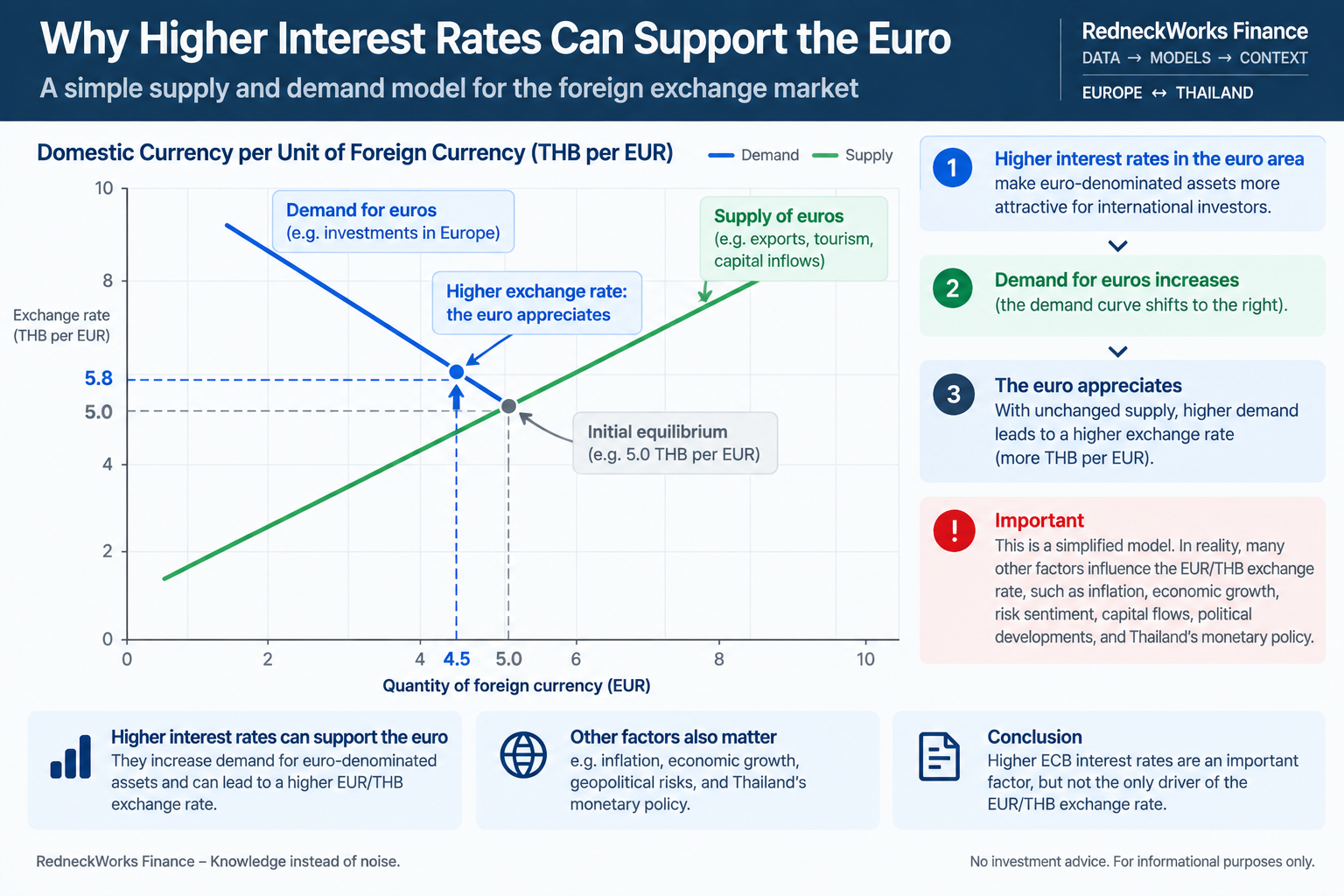
The relationship is not mechanical. Foreign-exchange markets trade expectations. If a rate hike has already been fully priced in, the euro can remain unchanged or even weaken after the decision.
Concrete EUR/THB scenarios for the next 1 to 3 months
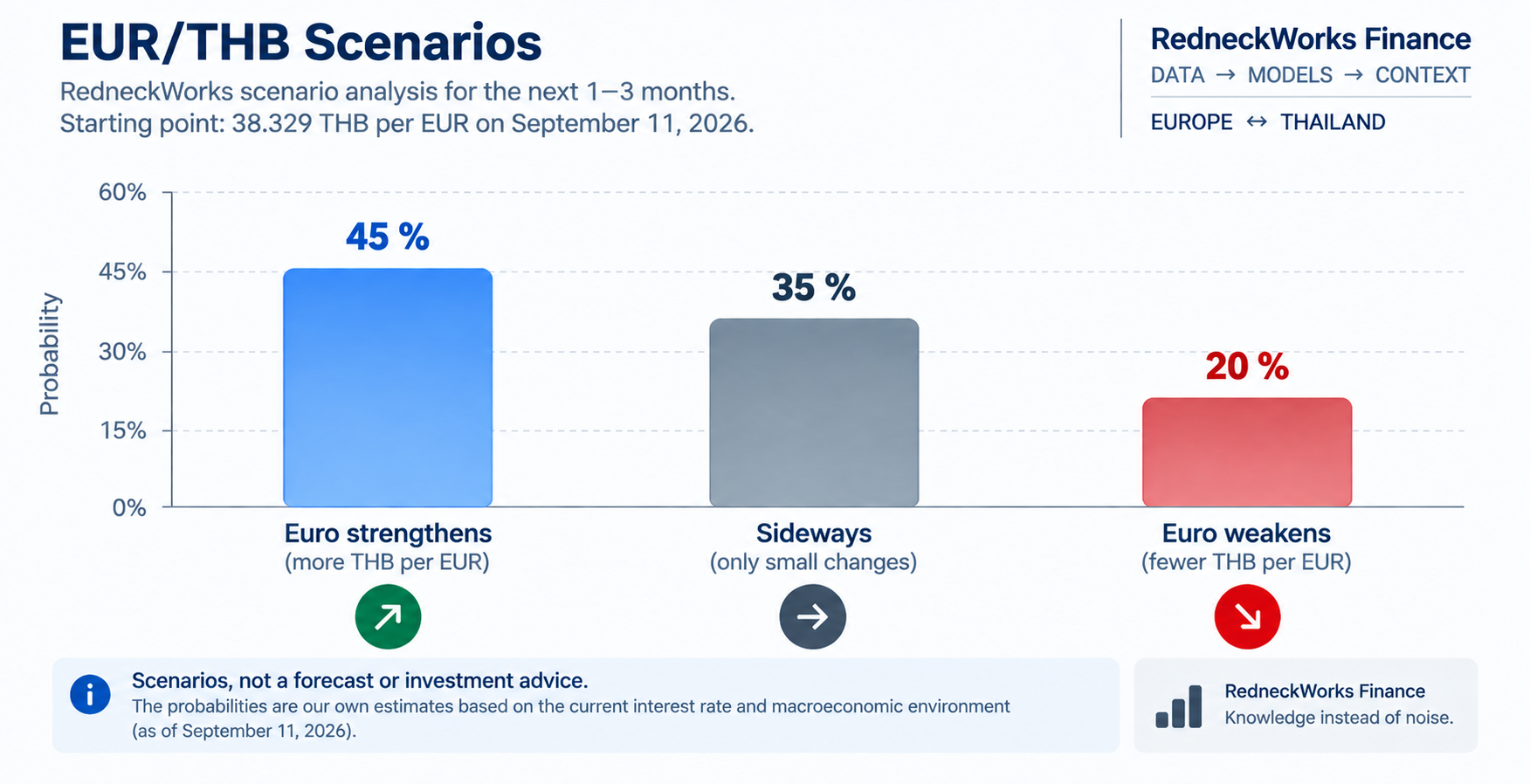
Based on the current rate differential, the policy signals from both central banks and current market pricing, the following scenario framework is plausible. The probabilities are RedneckWorks estimates, not directly traded EUR/THB probabilities.
Scenario | Probability | EUR/THB range | Interpretation |
Euro strengthens | 45% | 38.8–40.0 | More baht per euro |
Sideways | 35% | 37.8–38.8 | Limited change |
Euro weakens | 20% | 36.8–37.8 | Fewer baht per euro |
The base case is therefore a stable to moderately stronger euro. For the coming weeks to a few months, a central range of roughly 38.5 to 39.5 THB per euro appears plausible.
What would 39 or 40 THB mean?
Rate | Change from 38.329 |
39.00 | +1.75% |
39.50 | +3.06% |
40.00 | +4.36% |
37.50 | −2.16% |
37.00 | −3.47% |
How likely is another ECB rate hike?
For the next ECB meeting on October 29, 2026, market-implied pricing recently suggested roughly a 50% probability of another increase. The probability of at least one further increase by year-end was much higher, at around 89%.
These probabilities can change quickly with inflation data, energy prices, wage growth and economic activity. The ECB itself explicitly avoids committing to a preset rate path and decides meeting by meeting.
What supports a higher EUR/THB rate?
Another ECB rate increase while the Thai policy rate remains unchanged.
Persistently high inflation in the euro area.
A Bank of Thailand that keeps rates low to support domestic activity.
High energy prices that may weigh on Thailand as a net energy importer.
Capital flows toward higher-yielding euro assets.
What could weaken the euro against the baht?
A faster decline in euro-area inflation and less need for further ECB tightening.
A more restrictive Bank of Thailand than markets currently expect.
Stronger capital inflows into Thailand.
Better-than-expected Thai growth or stronger tourism receipts.
Global risk-on flows favoring Asian and emerging-market currencies.
Three scenarios
1. Another ECB rate hike
If the ECB raises rates again in October or by December and the Bank of Thailand remains at 1.00%, a move toward 39 to 40 THB per euro would be a plausible positive scenario.
2. Both central banks stay unchanged
If policy rates remain unchanged and macroeconomic data do not surprise, a sideways move around 38 THB per euro would be the most likely outcome.
3. The ECB turns more cautious or the baht strengthens
If euro-area inflation pressure and rate expectations fall faster than expected, or Thailand benefits from strong capital inflows, EUR/THB could move back toward 37 to 37.5.
Conclusion
The current rate configuration favors a stable to moderately stronger euro against the Thai baht. The ECB deposit facility rate is 2.50%, while the Bank of Thailand is holding its policy rate at 1.00%. Another ECB increase would widen the interest-rate differential further.
For the next one to three months, we therefore view 38.5 to 39.5 THB per euro as a plausible central range. In a scenario with further ECB tightening, EUR/THB could also move toward 40. A more cautious ECB or a stronger baht could instead push the rate back toward 37 to 37.5.
These ranges are scenarios, not price targets or investment advice. Exchange rates respond to interest rates, inflation, capital flows, energy prices and, above all, the difference between market expectations and actual policy outcomes.
Sources
European Central Bank – Monetary policy decisions, 10 September 2026
European Central Bank – Euro foreign exchange reference rates: Thai baht
Bank of Thailand – Monetary Policy Committee decision, 26 August 2026
Reuters – ECB policymakers and further tightening expectations