
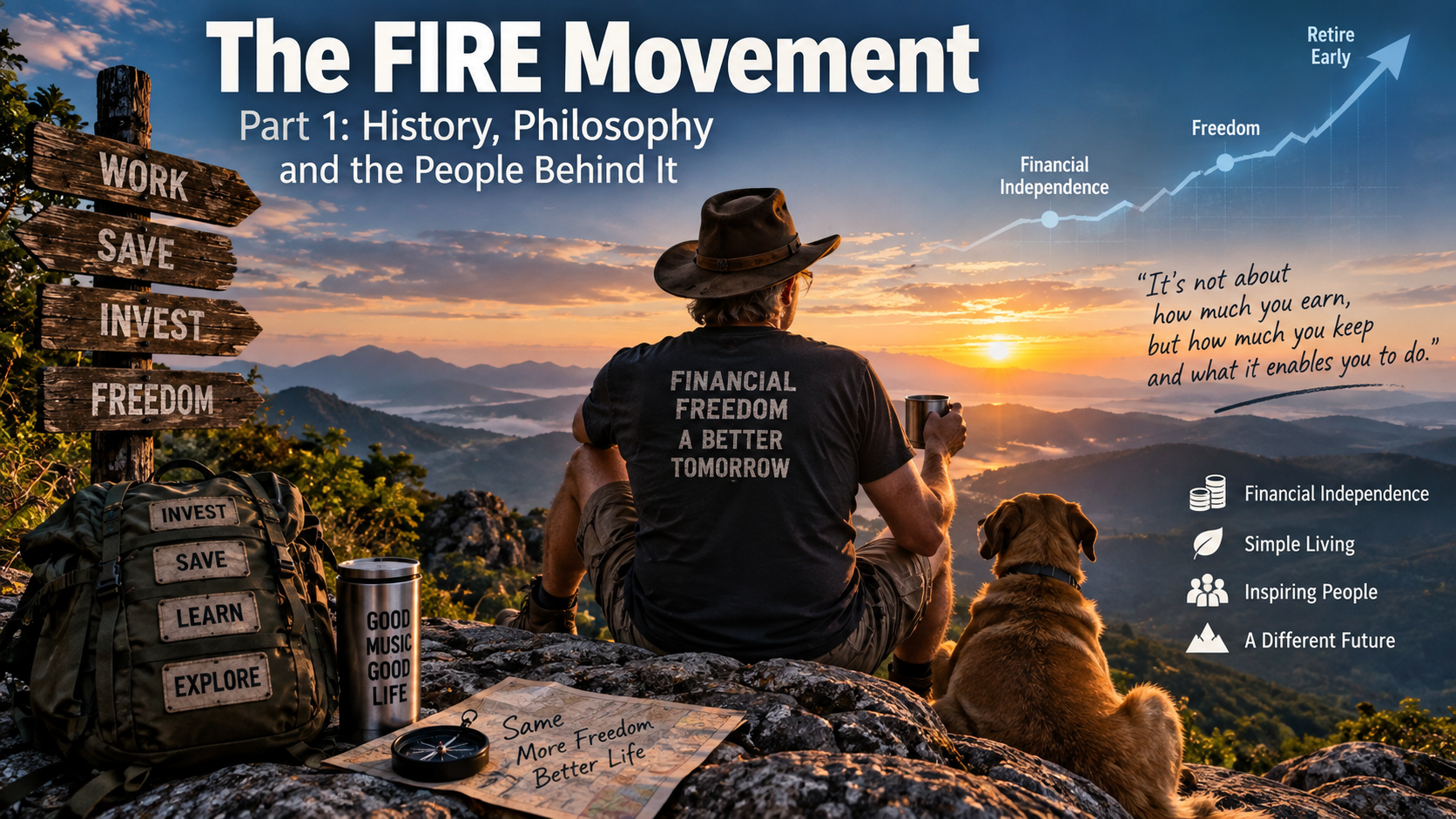
The FIRE Movement – Part 1: History, Philosophy and the People Behind It
Where did the FIRE movement come from? Part 1 explores Joe Dominguez, Vicki Robin and Mr. Money Mustache and the philosophy behind Financial Independence, Retire Early: reducing dependence on paid employment and gaining greater control over your time.
Financial Independence, Retire Early – FIRE – is often reduced to a simple formula: save aggressively, invest the difference and stop working as early as possible. But the idea is older and philosophically more interesting. At its core is a broader question: what role should money and paid work play in our lives, and how much of our limited lifetime do we want to keep exchanging for income?
The Idea Is Older Than the Term FIRE
FIRE was not invented by a single person. The modern movement combines older ideas of voluntary simplicity and conscious consumption with systematic wealth building. Two particularly important predecessors were Joe Dominguez and Vicki Robin. Their work turned financial independence from a purely financial objective into a question of time, life energy and personal priorities.
Joe Dominguez: Financial Independence at 31
Joe Dominguez was born in 1938 and grew up in Spanish Harlem in New York City. In her history of “Your Money or Your Life,” Vicki Robin recounts that Dominguez had already identified financial independence as a personal goal while he was still a student. He later worked as a financial analyst on Wall Street.
Instead of continually expanding his lifestyle as his income increased, Dominguez saved a large share of what he earned. In 1969, shortly before his 31st birthday, he considered himself financially independent: his accumulated capital could provide enough income to cover his needs.
What happened next is important. Dominguez did not understand financial independence as decades of doing nothing. Penguin Random House describes him as a full-time volunteer from 1969 onward; income from his later teaching activities was donated to projects he supported. His story illustrates an idea that remains central to FIRE today: the objective is not necessarily to eliminate work, but to eliminate the economic necessity of having to work.
Vicki Robin: Money Becomes a Question About Life
Vicki Robin brought another perspective to this development. Together with Dominguez, she transformed his personal path into a more systematic framework. A financial strategy increasingly became a philosophy about money, consumption and the way people design their lives.
The central idea can be expressed simply: money is not merely a number in a bank account. Most people have to exchange part of their lifetime for the money they earn. An expense therefore has more than a price in dollars or euros. A second question becomes possible: how many hours of my life did I have to exchange for this purchase?
This perspective changes the way consumption can be evaluated. Commuting, work-related expenses and time surrounding paid employment can also form part of the real cost of earning an income. Money and lifetime become directly connected.
1992: Your Money or Your Life
In 1992, Joe Dominguez and Vicki Robin published “Your Money or Your Life: Transforming Your Relationship with Money and Achieving Financial Independence.” The book later became one of the most influential reference works for people interested in financial independence.
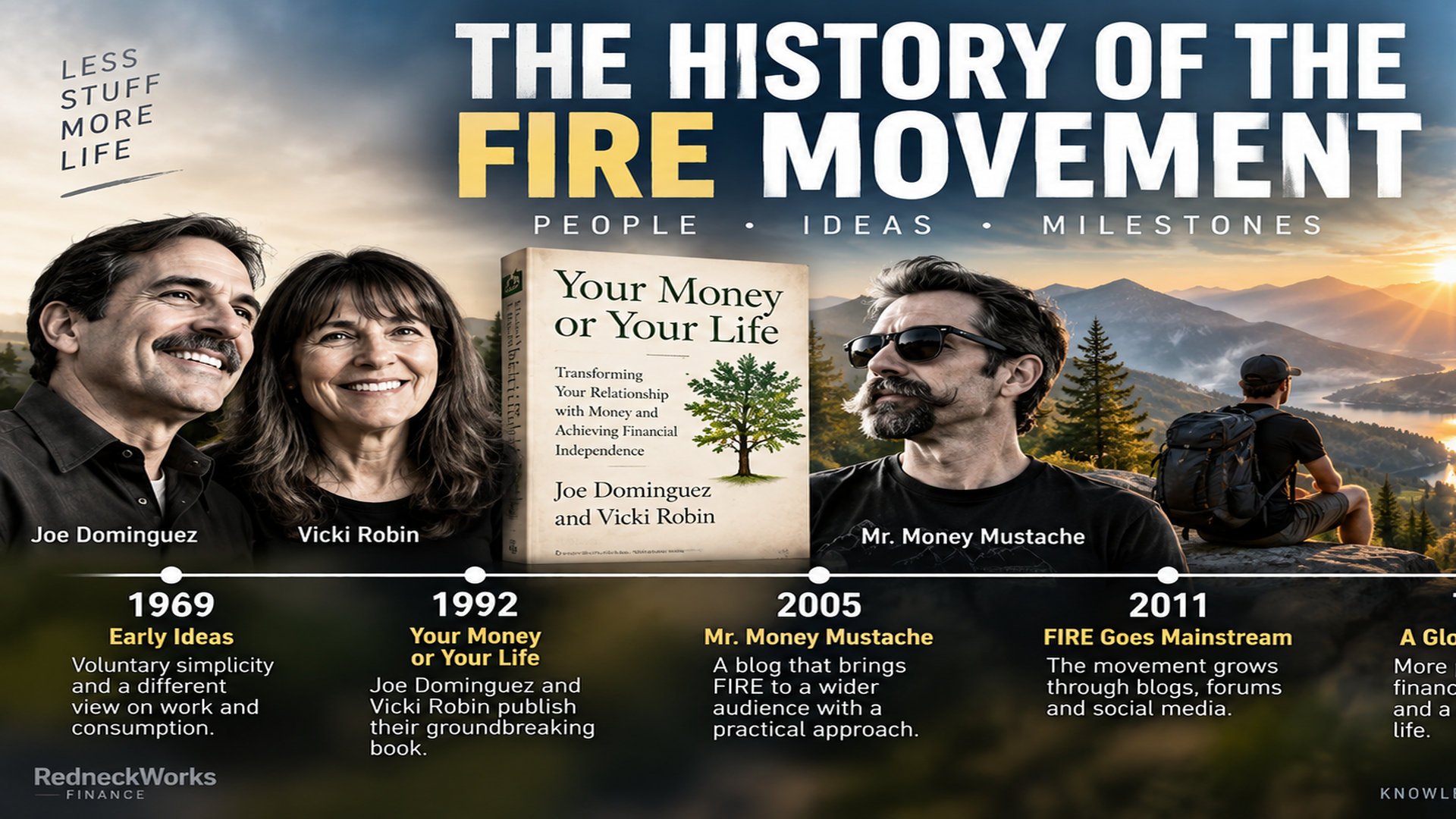
The subtitle itself is revealing. The focus is not on reaching a particular retirement age. It is about changing the relationship with money and achieving financial independence. That is the philosophical core that would later become part of the FIRE movement.
Financial Independence May Matter More Than Retire Early
The term FIRE naturally draws attention to “Retire Early.” Stories about people retiring at 35 or 40 are easy to turn into headlines. Yet the more interesting part of the concept is often “Financial Independence.”
Financial independence does not have to mean never working again. It can mean working fewer hours, accepting only projects that are genuinely interesting, starting a business, writing, teaching or even continuing in the same profession. The difference is that the next paycheck no longer determines whether ordinary living expenses can be paid.
Separating Work from Income
The traditional life model can be simplified as education, several decades of paid employment and finally retirement. FIRE questions that sequence. Why should economic freedom necessarily begin only at the traditional retirement age?
This does not imply that work is inherently negative. People can derive considerable purpose and satisfaction from their work. Financial independence instead attempts to separate work, at least partially, from economic necessity.
Consumption Takes on a Different Meaning
As income rises, lifestyle expenses often rise as well. A larger home, a more expensive car and higher recurring costs can mean that a higher income simultaneously creates greater dependence on maintaining that income.
The FIRE philosophy offers an alternative: part of today's income can be used to build future freedom of choice. Saving is therefore not merely deprivation. It becomes a trade-off between present consumption and future autonomy.
What Happened to Joe Dominguez?
Joe Dominguez died in 1997. He did not live to see the later global FIRE movement or its expansion through blogs and social media. His ideas continued through “Your Money or Your Life,” educational material and Vicki Robin's subsequent work.
Vicki Robin Today
Vicki Robin continued her work after Dominguez's death. She remains engaged with financial independence, frugality, sustainability, community and intentional living. In 2026 she continues to publish material on these subjects. Her current perspective still emphasizes that financial independence should not simply be equated with early retirement.
Then Came the Internet
An academic study of the FIRE community describes the modern online movement as beginning to crystallize around a collection of blogs from roughly 2005 onward. The launch of Mr. Money Mustache in 2011 is identified as an important turning point in the consolidation of the community.
Peter Adeney: Mr. Money Mustache
Peter Adeney and his then-wife worked in the technology industry. According to Adeney's own account, they lived well below their means, invested the surplus in assets including low-cost Vanguard index funds and real estate, and left their regular jobs in 2005.
In 2011, Adeney launched the blog “Mr. Money Mustache.” His language was more provocative than that of Dominguez and Robin. He challenged lifestyle inflation, high recurring costs and consumption-driven habits, helping bring the idea of financial independence to a much larger internet audience.
Interestingly, Adeney wrote in late 2011 that after starting his blog he discovered an existing community already using terms such as FI, FIRE and SWR. He therefore did not invent FIRE, but became one of the most important popularizers of the modern online movement.
How Does Mr. Money Mustache Live Today?
His later life also illustrates the limitations of the phrase “Retire Early.” Adeney did not disappear into passive retirement after leaving conventional employment. His blog, hands-on and entrepreneurial projects, family and other activities continued to occupy his time. The blog remains active in 2026.
Perhaps FIRE Needs a Different Name
Dominguez left conventional employment and devoted himself to projects and volunteer work. Robin used her financial freedom for books and wider social questions. Adeney left his conventional technology career and later devoted substantial time to writing and other projects.
None of these lives fits particularly well with the image of retiring early and then doing nothing. Perhaps the FI in FIRE is therefore more important than the RE.
Work Optional
A more accurate description might be “Work Optional.” The objective would not be to stop doing anything as early as possible. It would be to reach the point where you can decide whether to work, how much to work and what to work on.

Ultimately, this is about a resource that, unlike money, cannot be earned again: time. Money can be earned, lost, invested and earned again. Lifetime cannot.
That leads directly to the practical question for Part 2: how much wealth does a person actually need before paid work becomes economically optional?
Sources
Vicki Robin – History of Your Money or Your Life
Penguin Random House – Joe Dominguez
Taylor & Francis – The financialization of anti-capitalism? The case of the FIRE community
Mr. Money Mustache – Are You Obsessed with Early Retirement?