
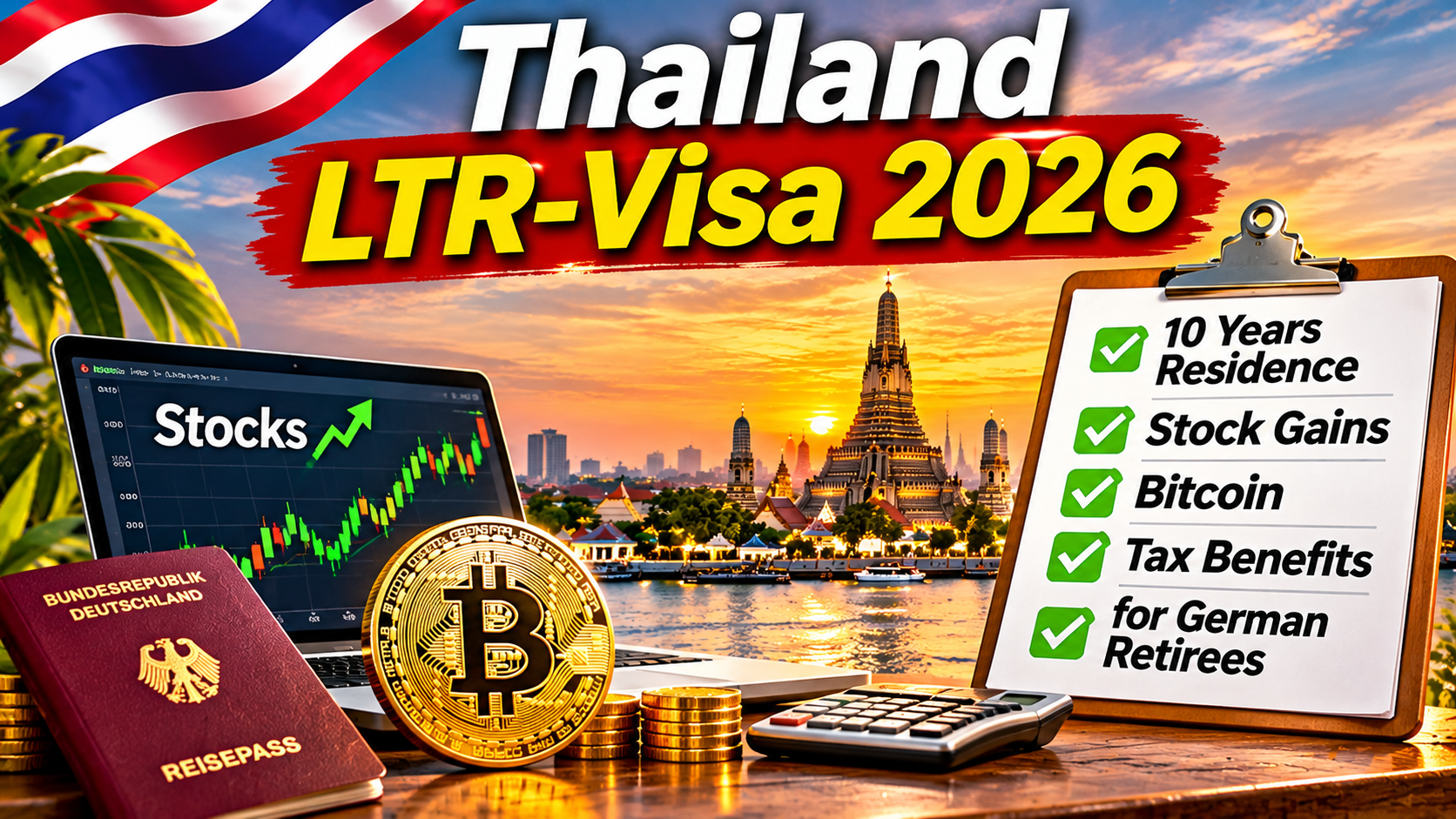
Thailand LTR Visa 2026: Ten Years of Residence, Stock Gains, Bitcoin and Tax Benefits for German Retirees
Thailand’s LTR Wealthy Pensioner visa for German nationals: $80,000 or $40,000 passive income, €1m portfolio scenarios, German pensions, Bitcoin, hybrid Thai investments and Germany–Thailand tax treaty questions.
How German nationals with a €1 million stock and ETF portfolio might qualify for Thailand’s Long-Term Resident Visa: illustrative calculations, investment options and unresolved questions for the BOI.
RedneckWorks Finance Research | November 2026
Introduction: Thailand is targeting financially independent long-term residents
Thailand has long attracted European retirees with its climate, infrastructure, private healthcare and relatively affordable lifestyle. Its economic strategy increasingly seeks financially independent foreign residents who can contribute spending and investment over the long term. This does not mean that lower-budget visitors are unwelcome. Rather, the Long-Term Resident (LTR) Visa, launched in 2022, illustrates the government's preferred target groups.
Scope: German nationals and the Germany–Thailand tax treaty
This article is written specifically for German nationals considering retirement in Thailand who receive German pensions or hold securities and other investments. The tax discussion focuses on German and Thai law and the 1967 double taxation agreement (DTA) between Germany and Thailand. Treaty entitlement depends primarily on tax residence and the classification of the income, not citizenship alone. Other nationalities may face different treaty rules and tax outcomes.
What we examine
Our hypothetical investor owns €1,000,000 in stocks and ETFs, with gross monthly retirement income of either €2,500 or €3,000. We examine statutory pensions, occupational pensions, Riester payments, realized stock gains, dividends, bonds, Thai property, hybrid investments and Bitcoin. A central unresolved question is whether the $80,000 income threshold must be met every year or is primarily assessed at application and five-year renewal. Where official guidance is inconclusive, we say so.
1. What is Thailand’s LTR Visa?
The Board of Investment (BOI) administers the LTR program, introduced in 2022 for several groups including wealthy individuals, pensioners and highly skilled professionals.
Key features include:
Permission to stay for up to ten years, initially five years followed by reassessment for another five
Generally annual rather than 90-day address reporting
Facilitated re-entry
Certain tax benefits for eligible LTR categories
Greater long-term planning certainty
The visa is not permanent residence. Eligibility requirements must continue to be satisfied. Official information: https://ltr.boi.go.th/
2. Wealthy Pensioner: Two eligibility routes
Applicants must generally be at least 50 years old and demonstrate qualifying passive income.
Requirement | Route A | Route B |
|---|---|---|
Minimum age | 50 | 50 |
Annual passive income | At least $80,000 | At least $40,000 |
Additional qualifying Thai investment | Not required | At least $250,000 |
Medical coverage or qualifying alternative | Required | Required |
Route A: $80,000 passive income
Applicants meeting the higher income threshold do not need the additional $250,000 Thai investment.
Route B: $40,000 passive income plus investment
Applicants with at least $40,000 but less than $80,000 qualifying passive income may be eligible with a qualifying Thai investment of at least $250,000. A large brokerage balance by itself does not replace the income requirement.
3. What counts as passive income?
BOI guidance identifies categories such as pensions, dividends, interest, rental income, royalties and realized capital gains. Active employment income generally does not qualify for the Wealthy Pensioner category.
Realized gains are not sale proceeds
Item | Amount |
|---|---|
Stock sale proceeds | $100,000 |
Acquisition cost | $54,000 |
Realized gain | $46,000 |
The gain is $46,000, not $100,000. Unrealized portfolio appreciation is not a realized gain. BOI acceptance of particular broker statements and tax records should be confirmed.
Dividends and ETF distributions
Dividend income may qualify, but ETF distributions can contain different components. Covered-call funds, for example, may distribute income from options strategies or return of capital. The full cash distribution should not automatically be treated as qualifying passive income.
4. Model portfolio: €1 million in stocks and ETFs
We assume €1,000,000 invested and an illustrative exchange rate of €1 = $1.15. This is not a forecast or the BOI's official rate.
Annual return or income rate | Amount |
|---|---|
1% | €10,000 |
2% | €20,000 |
3% | €30,000 |
4% | €40,000 |
5% | €50,000 |
6% | €60,000 |
8% | €80,000 |
A 6% total return does not necessarily create €60,000 in recognized passive income. The investor must demonstrate actual qualifying receipts or realized gains.
5. Model A: €2,500 monthly pension and the $80,000 route
A gross pension of €2,500 per month equals €30,000 per year, or $34,500 at the assumed exchange rate.
Income source | Annual amount |
|---|---|
Gross pension | $34,500 |
Additional qualifying investment income required | $45,500 |
Total | $80,000 |
The shortfall of $45,500 equals approximately €39,565, or 3.96% of the initial €1 million portfolio. If those qualifying gains or receipts are actually earned, evidenced and accepted by the BOI, the higher income route is mathematically achievable without a $250,000 Thai investment.
6. Model B: €2,500 monthly pension plus a Thai investment
The lower income threshold is $40,000. Against the $34,500 pension, only $5,500 additional qualifying passive income is required.
Income source | Annual amount |
|---|---|
Gross pension | $34,500 |
Additional qualifying investment income required | $5,500 |
Total | $40,000 |
That is approximately €4,783, or 0.48% of the initial portfolio. However, the applicant must also make and maintain a qualifying $250,000 investment in Thailand.
7. Model C: German state pension, occupational pension and Riester
Our third hypothetical case assumes gross combined retirement income of €3,000 per month.
Pension component | Monthly | Annual |
|---|---|---|
German statutory pension | €2,000 | €24,000 |
Occupational pension | €600 | €7,200 |
Riester pension | €400 | €4,800 |
Total | €3,000 | €36,000 |
At €1 = $1.15, total annual income is $41,400.
Route B: $40,000 plus investment
If the BOI accepts all three pension components in full, the income requirement is already met. The qualifying Thai investment of at least $250,000 is still mandatory.
Route A: $80,000 without investment
Income source | Annual amount |
|---|---|
Combined pensions | $41,400 |
Additional qualifying investment income required | $38,600 |
Total | $80,000 |
The additional $38,600 is approximately €33,565, or 3.36% of the initial €1 million portfolio.
Open issue: Whether German occupational pensions and Riester distributions qualify in full may depend on their contractual structure and payout method. Written BOI confirmation is advisable.
8. Must the $80,000 threshold be met every year?
Realized investment gains can vary sharply between years. A retiree might realize $50,000 one year and sell nothing the next.
The LTR program initially grants five years, with a qualification reassessment before the next five years. It does not ordinarily require a complete new application each year. However, BOI guidance also says eligibility conditions must be maintained throughout the visa period.
No annual reapplication does not necessarily mean the annual income condition disappears. Published guidance does not conclusively explain how years with unusually low or zero realized capital gains are treated between formal reviews. Applicants relying on fluctuating gains should seek a written BOI interpretation.
BOI February 2026 material: https://ltr.boi.go.th/documents/LTR_Community_day_19_Feb_2026.pdf
9. Applicant experiences on Reddit
Reddit discussions contain anecdotal accounts of different income-documentation requests, including claims that one or two years of evidence were requested, and accounts of using brokerage records. These statements are not independently verified and cannot establish an official rule. Individual BOI caseworkers may request additional supporting documents.
Discussions: https://www.reddit.com/r/ThailandTourism/comments/1n70w7p/ltr_wealthy_pen_visa/
10. The $250,000 investment: Bonds, property or a hybrid
The lower-income route requires at least $250,000 in qualifying Thai investments. BOI-listed categories include qualifying Thai government bonds, property and eligible direct company investments.
Thai government bonds
Qualifying bonds must satisfy the applicable maturity requirement, including a remaining maturity of at least five years. Bonds avoid property management and may provide predictable coupons, but they expose investors to interest-rate, liquidity and potentially currency risks.
Thai property
A qualifying condominium could provide a home as well as an investment. Foreign ownership restrictions, documentary requirements, taxes, service charges and maintenance expenses must be considered.
Direct business investment
Some qualifying direct investments in Thai companies may count, subject to the precise BOI conditions.
Combining property and government bonds
Rather than committing the entire amount to one asset, an applicant may consider a combination of eligible categories.
Investment | Amount |
|---|---|
Qualifying Thai condominium | $150,000 |
Qualifying Thai government bonds | $100,000 |
Total | $250,000 |
This approach may diversify exposure and combine residential use with coupon income. The precise combination, valuations, ownership documents and bond eligibility should be confirmed with the BOI before purchasing.
11. Thai government bonds and US-dollar currency exposure
The investment threshold is expressed in USD, but this does not necessarily require a USD-denominated asset. At an assumed exchange rate of 35 THB per USD, $250,000 corresponds to 8,750,000 THB.
THB per USD | USD value of 8,750,000 THB |
|---|---|
30 | $291,667 |
35 | $250,000 |
40 | $218,750 |
This calculation excludes changes in bond market value, interest and fees. It demonstrates that currency fluctuations can affect the USD-equivalent investment value.
A US Treasury security does not qualify simply because it is denominated in dollars. Whether a specific USD-denominated Thai sovereign bond qualifies must be checked using its issuer, ISIN, currency, remaining maturity and valuation date.
12. Illustrative bond interest on $250,000
Hypothetical annual yield | Gross annual interest |
|---|---|
2.0% | $5,000 |
2.5% | $6,250 |
3.0% | $7,500 |
4.0% | $10,000 |
These are illustrative rates, not current market quotes. Thai-source interest may be taxable in Thailand and should not automatically be treated as exempt foreign-source LTR income.
13. Bitcoin: Do realized crypto gains count?
Investors may hold Bitcoin alongside stocks and ETFs. BOI guidance refers to realized capital gains as a potential passive-income category but does not clearly state whether Bitcoin or other cryptocurrency gains are included.
Bitcoin sale example | Amount |
|---|---|
Sale proceeds | $80,000 |
Acquisition cost | $30,000 |
Realized gain | $50,000 |
If accepted, the $50,000 realized gain could contribute to the income threshold. Merely holding Bitcoin, or having an unrealized price increase, does not establish qualifying annual income.
Does Bitcoin satisfy the $250,000 investment requirement?
Bitcoin is not among the expressly listed eligible Thai investment categories. A Bitcoin holding worth $250,000 should therefore not be assumed to meet the requirement.
Thai crypto tax rules through 2029
Thailand introduced a temporary income-tax exemption for certain gains from crypto transactions executed through appropriately licensed Thai digital-asset operators from 1 January 2025 through 31 December 2029. Trades through foreign exchanges are not automatically covered by that specific exemption. The LTR foreign-income exemption is a separate legal question.
Open question: Does the BOI recognize realized Bitcoin gains as passive income, what proof is required, and does the exchange's jurisdiction or licensing status matter?
14. Health insurance or a $100,000 bank balance
BOI eligibility generally offers alternatives involving qualifying medical insurance with at least $50,000 coverage, qualifying Thai social-security protection, or a qualifying $100,000 bank deposit held for at least twelve months.
A hypothetical €110,000 account balance equals $126,500 at €1 = $1.15. Acceptance depends on the actual account type and documentation. Investment portfolios should not be assumed to qualify for the deposit alternative. The precise treatment of fixed-term accounts should be verified against current BOI requirements.
Even where a deposit meets the visa rules, adequate health insurance may still be prudent.
15. LTR tax benefits for foreign-source income
Thailand's Royal Decree No. 743 provides an exemption for certain qualifying foreign-source income of eligible LTR holders, including the Wealthy Pensioner category, subject to statutory conditions.
Illustrative foreign-source income | Amount |
|---|---|
Dividends | $12,000 |
Realized stock gains | $35,000 |
Interest | $3,000 |
Total | $50,000 |
Qualifying income may be exempt from Thai personal income tax. This does not mean worldwide tax exemption. Foreign withholding taxes, tax liabilities in other jurisdictions and Thai-source income require separate analysis.
16. Tax residence in Thailand and Germany
An LTR visa does not automatically create Thai tax residence or end German tax obligations. Immigration permission, domestic tax residence and treaty taxing rights are separate matters.
Thai domestic law generally uses a 180-day presence threshold during a tax year. German residence can depend on retaining a home or habitual abode in Germany. Where both countries consider a person resident, the treaty rules must be examined.
17. The 1967 Germany–Thailand double taxation agreement
The bilateral treaty allocates taxing rights for different types of income. Article 18 is particularly relevant to pensions and related periodic payments, but the treatment can differ for German statutory pensions, occupational pensions, public-service pensions, private annuities, Riester benefits and retirement-account distributions.
Dividends, interest and capital gains must be assessed under the appropriate treaty provisions. Thai LTR tax relief does not eliminate taxing rights that Germany or third countries may retain. A qualified cross-border tax adviser should review individual cases.
18. LTR versus a conventional retirement visa
Thailand also offers conventional retirement arrangements, such as a Non-Immigrant O visa with annual extensions.
Feature | LTR Wealthy Pensioner | Conventional retirement arrangement |
|---|---|---|
Minimum age | 50 | Generally 50 |
Residence period | Up to ten years, subject to reassessment | Usually annual extensions |
Income test | $40,000 or $80,000 annually | Different, generally lower thresholds |
Additional investment | Required under the $40,000 route | No equivalent $250,000 LTR investment |
Reporting | Generally annual | Generally every 90 days |
Special LTR foreign-income relief | Potentially available | Not available merely through the retirement visa |
The conventional route may suit retirees with lower income; the LTR may appeal to investors with substantial qualifying foreign income.
19. Nine unresolved questions for the BOI
1. Income throughout the five-year period
Must the $80,000 threshold be met in every year, or is the main documentary test conducted at application and renewal?
2. Fluctuating realized stock gains
How are years with lower or zero realized gains treated between formal reviews?
3. International brokerage evidence
Are annual broker statements and transaction confirmations sufficient, or are tax assessments required?
4. German occupational and Riester pensions
Are these payments fully recognized as passive income, and does the payout structure affect eligibility?
5. USD-denominated Thai sovereign bonds
Can a specific USD-denominated Thai government bond qualify, subject to its ISIN and maturity?
6. Currency movements
How is a qualifying THB investment valued if exchange rates change during the visa period?
7. The $100,000 bank deposit
Which account types, locations and documents satisfy the deposit alternative?
8. Hybrid investment
Can qualifying Thai property and government bonds be combined toward the $250,000 threshold, and how are the components valued?
9. Bitcoin and other cryptocurrencies
Are realized crypto gains qualifying passive income? Which transaction records are required, and does the trading venue matter?
These questions should be resolved before making tax-triggering asset sales or committing a substantial amount to Thai property or bonds.
BOI LTR Visa Unit: ltr@boi.go.th | +66 2 209 1109 / +66 2 209 1110
Official FAQ: https://ltr.boi.go.th/page/faq.html
Document requirements: https://ltr.boi.go.th/page/required-documents.html
Exchange-rate information: https://ltr.boi.go.th/page/exchange-rates.html
20. Conclusion: A potential option for financially independent German retirees
Our hypothetical €1 million portfolio illustrates how qualifying pensions and investment income might support an LTR application. With €2,500 in gross monthly pension payments, approximately €39,565 of additional recognized annual investment income would be needed for the $80,000 route. With €3,000 monthly from statutory, occupational and Riester pensions, that figure falls to approximately €33,565, assuming all pension components qualify.
Under the $40,000 route, the €3,000 pension model would already meet the income threshold at the assumed exchange rate, but the $250,000 qualifying Thai investment remains mandatory. A hybrid of Thai property and government bonds may offer diversification, subject to BOI approval of the specific assets.
The status of Bitcoin gains and the interpretation of fluctuating annual realized gains remain important unresolved questions. Investors should obtain clarification before selling securities or acquiring qualifying assets. LTR eligibility, Thai tax exemptions and Germany's treaty taxing rights must always be analyzed separately.
Official sources and further reading
Thailand BOI LTR program: https://ltr.boi.go.th/
BOI FAQ: https://ltr.boi.go.th/page/faq.html
BOI required documents: https://ltr.boi.go.th/page/required-documents.html
BOI Wealthy Pensioner document list (November 2025): https://ltr.boi.go.th/documents/Required-docs-Wealthy-Pensioners-06-11-2025.pdf
BOI Community Day (February 2026): https://ltr.boi.go.th/documents/LTR_Community_day_19_Feb_2026.pdf
BOI visa issuance: https://ltr.boi.go.th/page/visa-issuance-info.html
BOI exchange rates: https://ltr.boi.go.th/page/exchange-rates.html
Thai Revenue Department: https://www.rd.go.th/english/
German Federal Ministry of Finance: https://www.bundesfinanzministerium.de/
Reddit applicant anecdotes (unverified): https://www.reddit.com/r/ThailandTourism/comments/1n70w7p/ltr_wealthy_pen_visa/
Further Reddit discussion: https://www.reddit.com/r/ThailandTourism/comments/1i485st/anyone_applied_for_and_received_ltr_wealthy/
Disclaimer: This article is intended for German nationals and provides general information only. It is not individualized tax, legal, immigration or investment advice. Tax treaty application depends on tax residence and income classification. All figures and exchange rates are hypothetical. Applicant anecdotes are not official evidence. Current BOI rules and applicable German and Thai law should be checked before publication or financial action.
Methodology and limitations
Hypothetical German-national investor with €1,000,000 in stocks and ETFs, gross pensions of €2,500 or €3,000 monthly, assumed €1 = $1.15 and $1 = THB 35. Calculations are illustrative, not projections. BOI treatment of individual income streams and tax classifications requires verification.